Why Life Feels Harder Than It Should, And How to Stop Suffering
Why Life Feels Harder Than It Should | Jo Renshaw Life Coach, Brighton
Understanding the Universal Human Paradigm
There’s a pattern I see in almost every woman I coach, whether she’s navigating midlife, leading a team, building a coaching business, parenting, or trying to make a relationship work. It’s the same pattern that appears when she feels stuck, overwhelmed, anxious, frustrated, or quietly disappointed with how life is unfolding. And it isn’t because she’s doing anything wrong. It’s because she’s unknowingly relating to life through a psychological phenomena called the Universal Human Paradigm, an invisible operating system shaping what we believe “should” and “shouldn’t” happen. This paradigm helps us to understand why life feels hard.
In this blog, you’ll learn what this paradigm is, why it creates unnecessary suffering, and how to step outside it so you can experience more peace, clarity, and emotional freedom. You’ll learn how to stop suffering, in a simple doable process, designed to reduce overwhelm and anxiety. You’ll see how it shows up in real women’s lives and walk away with a practical way to feel lighter, calmer, and more in control.
What the Universal Human Paradigm Actually Is
In her book, The Last Word on Power, Tracy Goss describes the Universal Human Paradigm as the unconscious structure that shapes how every human interprets the world. It’s the internal rulebook that decides what “should” happen and what “must not” happen. Most of us don’t even know we’re living inside this rulebook, we think we’re just “being realistic” or “protecting ourselves.” But this paradigm isn’t reality. It’s simply the brain’s attempt to control life so we can avoid emotional pain.
The human brain is wired to seek pleasure, avoid pain, and conserve energy. (Read more about that in the blog; Why Personal Development isn’t working for you) So of course it builds a set of internal rules to try to keep us safe. But those rules, those “shoulds” and “shouldn’ts”, become the very source of our suffering. Not because life is wrong, but because we’re fighting with life as it actually is.
The more rigid our internal rulebook, the more disappointment, anxiety, and emotional exhaustion we experience. And high-achieving women often have the most rigid rulebooks because they’ve spent years succeeding through control, preparation, self-reliance, and excellence.
What This Looks Like in Real Life
Let me show you how this plays out in the lives of three different women I’ve coached.
Helen had spent years holding herself back because of one defining disappointment. She’d gone for a job she badly wanted, delivered what she described as a “terrible interview,” and when she didn’t get the role, she was devastated. That experience became the template her brain used for everything that followed: don’t count on anything, don’t hope for too much, don’t put all your eggs in one basket, because when things fall through, you get crushed. This pattern extended into money as well. She wanted to bring in more income, maybe start a side gig, but every time she imagined stepping forward, the old rule resurfaced: “Life shouldn’t disappoint me again.” Instead of protecting her, it kept her from pursuing the very opportunities that could expand her future. She wasn’t avoiding disappointment, she was living inside it.
Another woman, Sarah, felt a rush of anxiety whenever her partner travelled or work got busy. The relationship was stable and loving, yet she found herself bracing for something to go wrong. Her mind forecasted disconnection as a way to stay in control, driven by the rule that life should stay predictable and connection shouldn’t fluctuate. When she recognised this as a protective reflex, not a sign that anything was wrong, her anxiety eased.
And then there was Laura, who believed her body “shouldn’t” look the way it does and that something was fundamentally wrong with her for struggling with weight. She thought this belief was deep and complicated, but it turned out to be simply well-practised. Her suffering came not from her body, but from the rule she’d internalised about how it should be. Releasing that rule softened everything.
Different women. Different circumstances. One pattern: suffering created not by life, but by the mind’s insistence that life be different from what it is.**
Why High-Achieving Women Feel This Paradigm the Most
Ambitious women often carry the most invisible pressure. They’ve built careers, families, relationships, and identities through effort, planning, and emotional resilience. They are used to handling things. They’re used to holding everything together.
So when life deviates from their rulebook, whether that’s a fluctuating relationship, a plateau in their business, a difficult week at work, or their body not responding the way they think it “should”, it feels like something has gone fundamentally wrong. Not just in life, but in them.
But nothing is wrong. This is simply the Universal Human Paradigm doing what it always does: trying to prevent anything painful from ever happening again.
How the Paradigm Creates Emotional Suffering
The moment life doesn’t match our internal rulebook, when reality deviates from what we believe should or shouldn’t be happening, we suffer.
We suffer because we resist the moment we’re in instead of meeting it. We brace for a future we fear rather than living the one we have. We argue with facts, personalise neutral circumstances, carry the past forward as a warning, and try to control what was never ours to control.
Helen’s disappointment wasn’t caused by how she performed at the interview. It came from the thoughts her brain offered about how she performed at interview, in the present. Sarah’s anxiety wasn’t about her partner, it was her brain trying to prevent imagined future pain. Laura’s struggle wasn’t with her body, it was with the belief that it shouldn’t be the way it is.
Suffering doesn’t come from circumstances. It comes from resisting what is.
How to Step Out of the Paradigm and Into Emotional Freedom
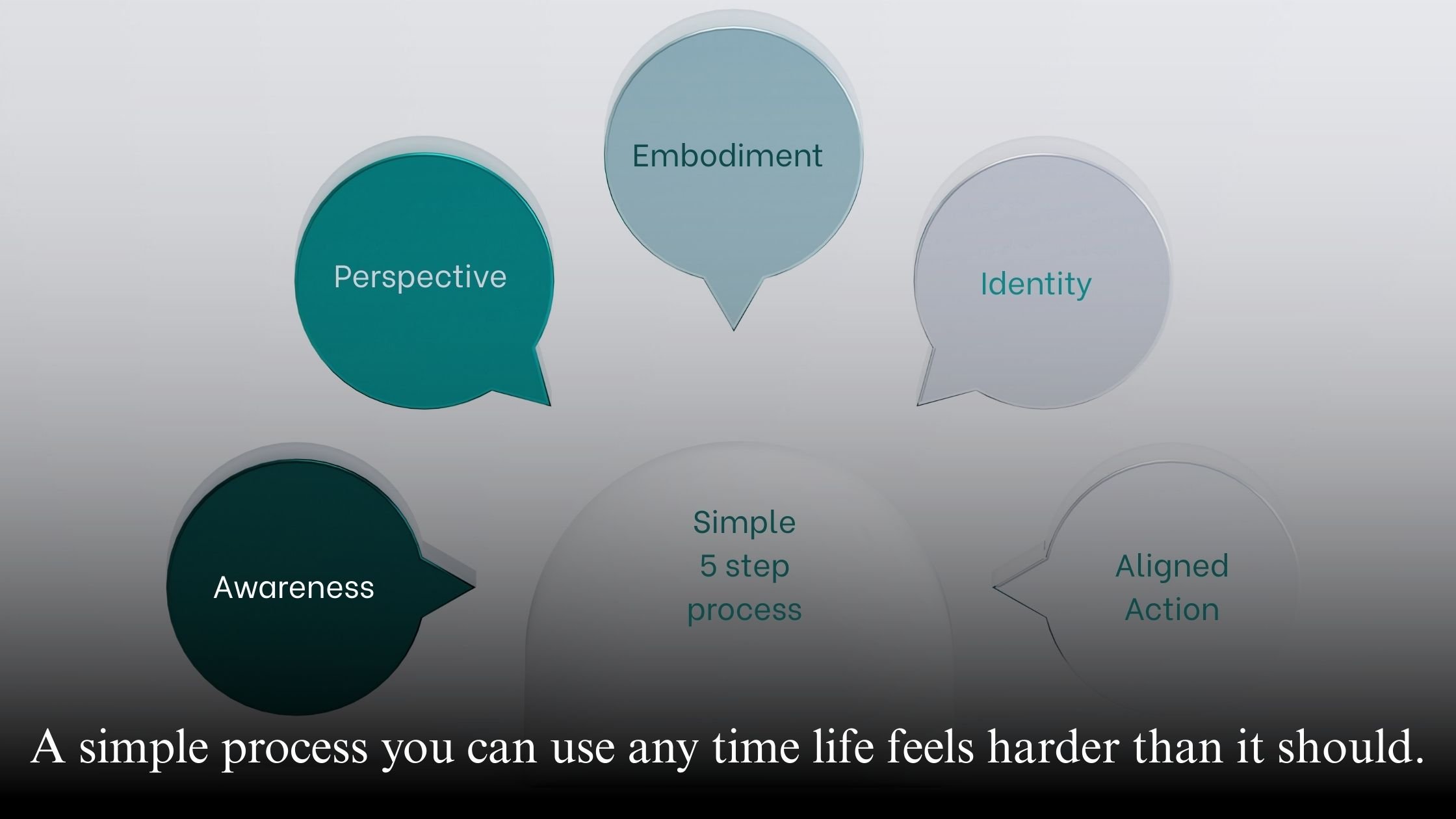
How to Step Out of the Paradigm: A Simple, Doable Process
The moment you recognise the Universal Human Paradigm at work, everything shifts. You stop living in reaction to your rulebook and begin choosing from presence, capability, and agency. Here’s the process.
Step 1 — Awareness
Notice the moment your brain says, “This shouldn’t be happening,” or “This must not happen.” These thoughts are signals, the paradigm speaking. You don’t need to change the thought instantly. Simply seeing it loosens its grip.
Step 2 — Perspective
Interrupt the pattern with one powerful question: “What if nothing has gone wrong?” This doesn’t dismiss your experience, it removes the assumption that the moment is a failure. It brings you back into reality instead of resistance.
Step 3 — Embodiment
Return to your body. Notice the tightness, heat, or fluttering without interpreting it. When you feel instead of analyse, you create space between stimulus and response, a space where you regain power.
Step 4 — Identity
Every challenge invites you into your next version. Ask yourself: “Who am I becoming right now?” This moves you out of the old rulebook and into power.
Step 5 — Aligned Action
Take one action from clarity rather than fear. That’s what allowed Helen to imagine a new possible future, Sarah to reconnect with herself and her partner, instead of spiral, and Laura to treat herself with compassion instead of punishment.
When you stop resisting life, life stops feeling like resistance.
The Freedom You Create When You Let Go of ‘Should’
When you loosen the grip of how life “should” be, you create room for how life can be. You become less reactive and anxious, and more open, connected, and steady. You begin trusting yourself to handle whatever comes, because you’re no longer fighting reality, you’re working with it.
That’s the beginning of real power. The power that comes from stepping outside the old paradigm and choosing your life from creative possibility rather than fear.
This is how you become your own best friend, and how you become a woman who can hold herself through anything.
Conclusion
Life will never perfectly match the rulebook your brain created. But the good news is, it doesn’t need to. The moment you stop resisting what is, you gain access to your deepest clarity, capability, and strength. You begin living from the present instead of the past, and from possibility instead of fear. And that is where your transformation truly begins.
If this resonates and you want to explore how to shift out of the “shoulds” and into a life that feels grounded, clear, and fully yours, I’d love to help you. Book a Discovery Call and let’s talk about the life you want to create, not the one your old rulebook is trying to protect you from.
This blog is inspired by the work I do with my clients during sessions, and brought to you in partnership with AI.


Feeling Stuck? Here’s How to Get Your Life Back on Track - Without the Overwhelm
Have you ever wished you had a personal coach to tell you exactly what to do to improve your life - without having to second-guess yourself, waste time figuring it all out alone, or add more to your already full plate?