Why Being Focused on Results Can Undermine Your Confidence
Why Results Focus Hurts Confidence | Jo Renshaw Life Coach, Brighton
In a recent coaching session, I noticed something that comes up far more often than people realise — especially in intelligent, high-performing adults.
In this blog, you’ll learn why being overly focused on results can quietly chip away at your confidence, how this shows up during learning and growth, and how to shift into a mindset that builds self-trust instead of self-judgement.
A Familiar Pattern for High Performers
My client had spent several hours studying for a professional exam. It was her first proper study session, her first time encountering the style of questions, and her first attempt at applying brand-new material. On paper, it was exactly what progress looks like.
But emotionally, she felt deflated.
As she talked, I could hear how hard she was being on herself. She described getting questions wrong, missing words, misreading prompts, and immediately making those moments mean something about her. Her mind moved quickly from “this is new” to “I should be better than this by now.”
The more she focused on the results of that study session, the worse she felt. Her motivation dipped. Her confidence narrowed. The work began to feel heavy instead of purposeful.
When Results Start to Feel Personal
From Feedback to Verdict
When someone is deeply results-focused, every outcome can start to feel like a verdict on who they are rather than information about what they’re learning.
That’s exactly what was happening here.
Each incorrect answer wasn’t just data. It became evidence. Proof, in her mind, that she was behind, not good enough, or doing something wrong.
In that state, practice feels dangerous. Mistakes feel exposing. Learning feels like confirmation of inadequacy instead of evidence of growth.
A Surprising Contrast
Studying vs Running
And then we switched topics.
I asked her about running.
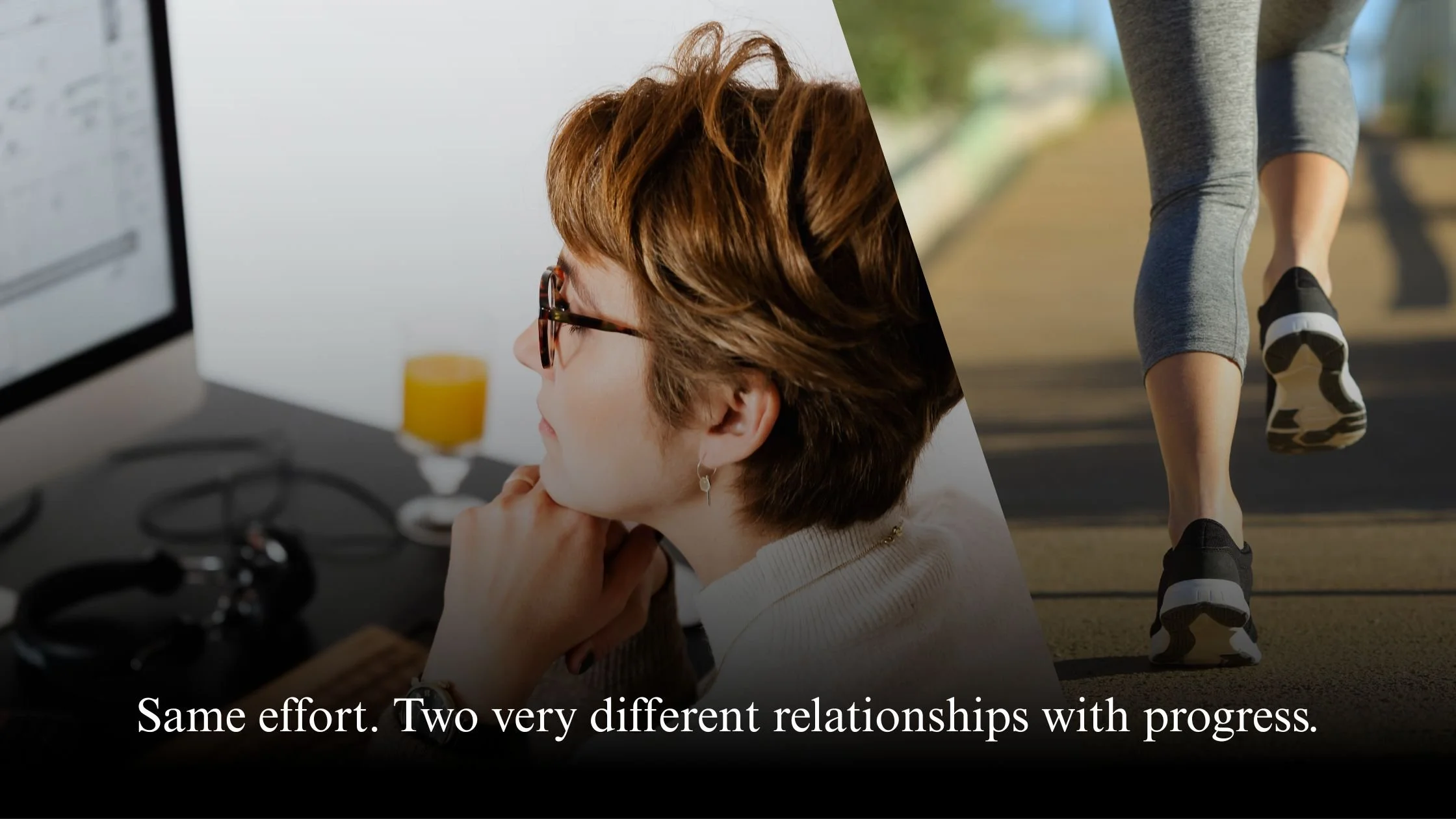
Running, it turns out, is something she approaches in a completely different way. When she goes for a run, she doesn’t expect perfection. She expects effort. She wants to feel tired, to know she’s shown up, to reach the end knowing she’s done the work.
Even when a run feels hard, it doesn’t spiral into self-judgement. She doesn’t decide it means she’s bad at running or that she shouldn’t bother next time.
Same person. Same capacity for discipline and focus. Two entirely different internal experiences.
That contrast mattered.
When she talked about studying, she was focused on the result in a way that made every outcome feel personal. When she talked about running, the result existed, but it wasn’t an identity statement. It was simply part of the process.
Results-Focused vs Results-Identified
The Subtle Difference That Changes Everything
Being results-focused is often praised. We’re told it’s a sign of ambition, drive, and high standards.
But there is a subtle difference between being results-oriented and being results-identified.
When results become a measure of who you are, rather than information about what you’re learning, self-trust starts to erode. You stop feeling safe to be in the learning phase. You start needing proof before you’ve earned experience.
That’s when progress becomes exhausting.
What Was Actually Happening
The Facts Were Neutral
What struck me most in the session was how neutral the facts actually were. She had studied for several hours, encountered unfamiliar material, answered some questions incorrectly, and then gone back to review them. That is exactly what early-stage learning looks like.
There was nothing wrong happening at all. The suffering came entirely from the story layered on top of those facts.
Borrowing a Healthier Mindset
Treating Practice Like Training, Not Performance
When we slowed things down, it became clear that running had taught her something studying hadn’t — not because running is easier, but because it had trained a healthier internal relationship.
Running already contained permission to improve over time. It assumed repetition, feedback, and adjustment. It expected effort before excellence.
So we borrowed that mindset.
Instead of treating practice tests as a referendum on intelligence or capability, we reframed them as training runs. Not performances. Not final exams. Just data-gathering exercises on the way to a larger goal.
How Evaluation Changes When You Stay on Your Own Side
From Blame to Curiosity
From that place, evaluation changes. It becomes calmer. More useful. Less emotional.
You start asking different questions:
What did I learn here?
What improved compared to last time?
What would I adjust next time?
Not from a place of blame, but from curiosity.
Why This Matters Beyond Exams
Business, Parenting, Health, and Change
This shift matters far beyond exams.
I see the same dynamic in business owners launching offers, professionals navigating career transitions, parents trying to “get it right,” and people working on their health.
When every outcome is treated as evidence of worth or failure, progress feels exhausting. When outcomes are treated as feedback, momentum becomes sustainable.
The Skill That Creates Lasting Change
By the end of the session, the real work wasn’t about improving test scores. It was about learning how to stay on your own side while you’re in the process of becoming better at something.
That is a skill most of us were never explicitly taught.
And yet it is one of the most powerful skills you can develop.
Because when you learn how to pursue results without turning them into self-judgement, you don’t just get better outcomes. You build trust with yourself. You stay engaged when things are uncomfortable. You keep showing up.
That’s what creates real, lasting change.
This blog is inspired by the work I do with my clients during sessions, and brought to you in partnership with AI.


Feeling Stuck? Here’s How to Get Your Life Back on Track - Without the Overwhelm
Have you ever wished you had a personal coach to tell you exactly what to do to improve your life - without having to second-guess yourself, waste time figuring it all out alone, or add more to your already full plate?