Stop Self-Sabotaging: How to Rewire Your Primitive Brain | Jo Renshaw Life Coach, Brighton
You had a win. Something you made, or pitched, or started, landed better than you expected, and for a moment you let yourself believe this could actually go somewhere.
Then, without any real decision to stop, you stopped.
If you've ever built momentum on something you cared about and then watched it stall for no reason you could point to, you're not lazy and you're not lacking discipline. Your brain did exactly what it's designed to do. In this post, I'll show you why success can feel more dangerous than failure, and I'll teach you the tool that lets you keep going anyway. You'll learn:
Why your brain treats a big win as a threat, not a triumph
The three primitive drives behind why you procrastinate and self-sabotage
A reframe that turns discomfort into fuel instead of a stop sign
A two-part daily practice that retrains your brain's default setting to help you overcome self sabotage
The Myth of Feeling Good First
Michelle came to coaching two years after the best afternoon her pottery side hustle had ever had. A stall at a local craft market, a table of bowls and jugs she'd thrown in her spare room, and she sold out within the hour. Strangers were asking where they could buy more. She went home that evening making plans: a proper online shop, a mailing list, maybe even wholesale to a couple of local shops.
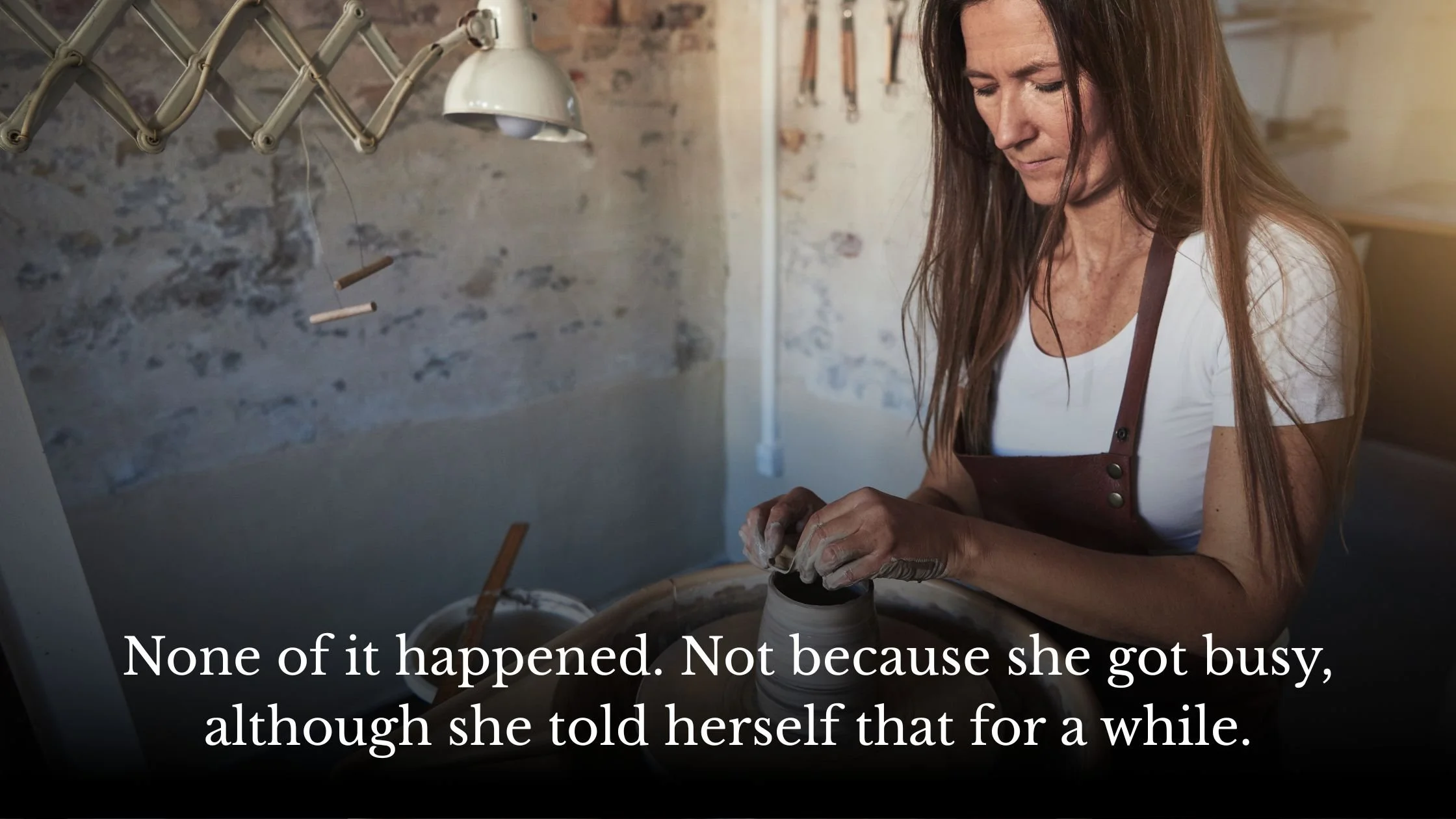
None of it happened.
Not because she got busy, although she told herself that for a while. Not because the interest faded, because people kept asking. It was something closer to an instinct that pulled her back every time she sat down to build the website or throw the next batch. A voice that said, what if that first sale was a fluke? What if a shop full of my work just proves I'm not as good as that one afternoon made me look?
Two years on, the wheel was still in the spare room, mostly unused.
This is what I call success intolerance, and it's far more common than people admit. We reach the thing we said we wanted, and instead of building on it, we quietly find reasons to protect ourselves from finding out if we can do it again. Even good emotions such as excitement and pride can feel dangerously out of control to a brain whose only job is to keep you safe.
Your Brain's Primitive Blueprint: The Motivational Triad
Here's the part that changed things for Michelle: none of this was a character flaw. It was biology doing its job a few thousand years too late.
Underneath your rational, decision-making brain sits a much older part, one that's been running the show for roughly two million years. That primitive brain has exactly one job: keep you alive. It does this through three drives, known as the Motivational Triad.
Avoid pain. Physical, emotional and mental. This is why a difficult decision, or the risk of being judged, gets flagged by your brain as dangerous, even when nothing is actually threatening your survival.
Seek pleasure. This drive once kept us fed, warm and reproducing. Today it shows up as scrolling, overeating, overspending or reaching for anything that offers instant relief from an uncomfortable feeling.
Use as little effort as possible. Conserving energy mattered when food was scarce. Now it shows up as procrastination, as putting things off, as finding a reason the website can wait another week.
This system kept humans alive long enough to fill the planet. It was never built to help us thrive, build a business, or finish a creative project. And it doesn't distinguish between real danger and the simple discomfort of being seen. Your brain reads embarrassment, disappointment and the fear of being judged as threats worth avoiding altogether, which is why it will quietly pull you away from the very thing you say you want. If procrastination or self-sabotage keeps showing up in the same place for you, it's worth readingwhy you avoid setting goals in the first place, because the pattern usually starts earlier than the moment you stall.

Inverting the Triad: The Path to Thriving
Once Michelle understood that her stalling wasn't a personal failing, she could start doing something more useful than beating herself up over it. Together we built what I call the Thriving Triad: the deliberate opposite of the primitive brain's default settings.
Use massive effort. Instead of conserving energy, commit to consistent, sustained action, even when it's inconvenient.
Move towards discomfort on purpose. Seek out the conversation, the deadline, the unfinished website, rather than the version of your day that avoids it. Discomfort isn't a warning sign here. It's the price of entry.
Delay gratification. Resist the pull of the quick, comfortable win in favour of the slower result that actually matters to you.
This isn't about ignoring fear or forcing positivity. It's about recognising that the fear will always be there when you're doing something that matters, and choosing to act alongside it rather than waiting for it to leave first.
The Power of Awareness: Introducing The Model
The tool that made this practical for Michelle is one I teach every client in some form, because it's the foundation for everything else: The Model.
The Model breaks any experience down into five parts:
Circumstance: the neutral fact of the world. In Michelle's case, a stall that sold out and a website that didn't exist yet.
Thought: the sentence your brain offers about that circumstance. "What if that was a fluke?"
Feeling: the emotion the thought creates. For Michelle, it was a mix of anxiety and inhibition.
Action: what the feeling drives you to do, or avoid. She avoided the wheel, avoided the website, filled the time with other things.
Result: the outcome, which always proves the original thought true. No new pieces, no shop, no evidence either way, which felt like confirmation that she'd been right to be afraid.
Once you can see your own Model laid out like this, you stop mistaking your thoughts for facts. "I might fail" is a sentence your brain is offering you, not a prophecy. And because your thoughts create your results, changing the thought is where real change starts. If you want to work through your own Model on paper,I've put together a free guide to using it here.

The Daily Awareness Practice
Understanding the mechanism is only useful if you can actually shift it day to day. Here are the two practices I gave Michelle, and give every client working through this.
The Negativity Divert
Your brain has a natural bias towards the negative. Left unchecked, it will always find you the one thing that went wrong over the ten things that went right, a pattern well documented in research on thebrain's negativity bias. You have to deliberately train it in the other direction.
The practice: each day, write down ten things that went well. It doesn't matter when, bedtime works well for most people. At first you might struggle to find more than two or three. Keep going. The list gets longer as you practise it, and so does your brain's willingness to look for the good without being asked.
Holding Space for Your Inner Critic
When fear, shame or anxiety show up, most of us respond with a version of the same beatdown: harsh self-criticism dressed up as motivation. It rarely works, because when a beatdown is coming, we hide from ourselves rather than move towards what we're avoiding.
The practice: the next time you notice yourself spiralling, pause and ask yourself, with real warmth, "what's the matter, love?" Approach the anxious or ashamed part of you the way you'd approach a friend in distress, with curiosity rather than judgement. If this feels like a stretch right now,this piece on why being hard on yourself never creates change is a good place to start.
You are not the frightened part of you, and you're not the harsh critic either. You're the one in the middle, choosing which voice to listen to.
Recognising the Pattern Is the First Step
Michelle didn't need a better website template or more free time. She needed to see that her stalling had a reason, and that the reason wasn't a lack of talent or discipline. Once she could see her own Model, the fear of failing didn't disappear, but it stopped being the thing that got to decide.
This is the work: not eliminating discomfort, but learning to act alongside it. Your primitive brain will keep offering you reasons to stay small and safe. That's its job. Yours is to notice the thought, choose on purpose, and keep moving even when the outcome feels uncertain.
Ready to work through your own pattern of stalling before you start?Book a Consultation Call and let's find out what's really behind it, and what becomes possible once you do.
This blog is inspired by the work I do with my clients during sessions, and brought to you in partnership with AI.



Feeling Stuck? Here’s How to Get Your Life Back on Track - Without the Overwhelm
Have you ever wished you had a personal coach to tell you exactly what to do to improve your life - without having to second-guess yourself, waste time figuring it all out alone, or add more to your already full plate?